Frequently asked questions about liquidTMS
The introduction of liquidity planning software often raises questions -
about integration into existing systems, data security or the specific benefits compared to Excel solutions.
Here we answer the most important questions about liquidTMS,
its possible applications and the technical basics of liquidity management.
What is liquidity planning?
Liquidity planning refers to the systematic planning and management ofa company's incoming and outgoing paymentswith the aim of having sufficient liquid funds available at all times and being able to fulfil payment obligations on time.
To this end, expected cash flows are analysed and forecasts of the future development of liquidity are prepared. While cash flow describes the actual cash flows over a period of time, liquidity planning focuses on ensuring future solvency.
What added value does liquidTMS offer compared to Excel?
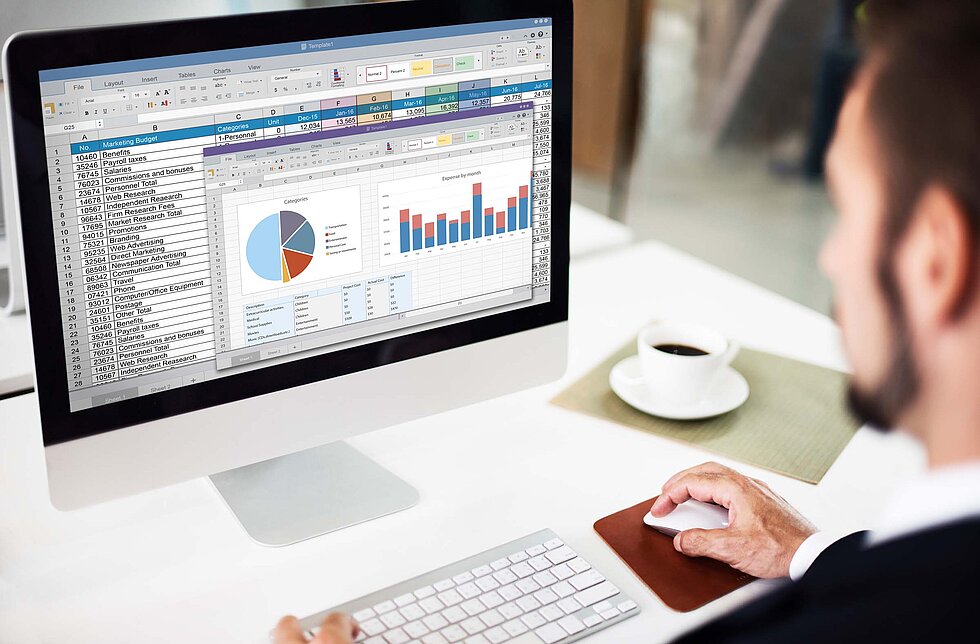
Excel solutions are flexible, but highly dependent on people and prone to errors.
liquidTMS works with variable and automated data connections from different upstream systems (e.g. ERP and financial accounting systems) and banks, clear processes and systematic forecasting with the support of machine learning.
This means
- Less manual effort
- Greater automation
- Lower error rate
- Consistent database
- Transparent traceability
You gain a reliable basis for business decisions, independent of individual employees.
How flexible is the software in mapping different
company structures, bank accounts and currencies?

In liquidTMS, companies can be mapped according to the respective corporate structure .
The companies can be mapped both individually and in the consolidated view, and it is also possible to map subgroups.

liquidTMS is able to connect the bank accounts of all German banks as well as a large number of European banks.
These include: Belgium, France, Italy, the Netherlands, Austria, Romania, Slovakia, Slovenia, Spain, the Czech Republic, Hungary and the United Kingdom.
In liquidTMS, foreign currency companies can be mapped in the local currency. It is also possible to show foreign currency companies in the Group currency.
The translation is based on the exchange rate tables of the European Central Bank.

How does the data connection work?
The connection to existing upstream systems is quick and uncomplicated via automated data integration. liquidTMS uses open, standardised interfaces to read in data from various sources (e.g. ERP or financial accounting systems). An Excel import can also be used. The data is automatically transferred and regularly updated.
Banks can be connected via PSD2-compliant bank APIs based on the XS2A principle or via the EBICS procedure.
How is data security guaranteed?
liquidTMS is based on a cloud-native architecture and is hosted in Microsoft Azure data centres in Germany.
This means that all data benefits from high security, compliance and availability standards as well as encryption mechanisms and certified cloud services from Microsoft.